Shavon Norris and Germaine Ingram talk "The Becoming"
This project examines what it means to be an elder along the continuum of the Black female experience.
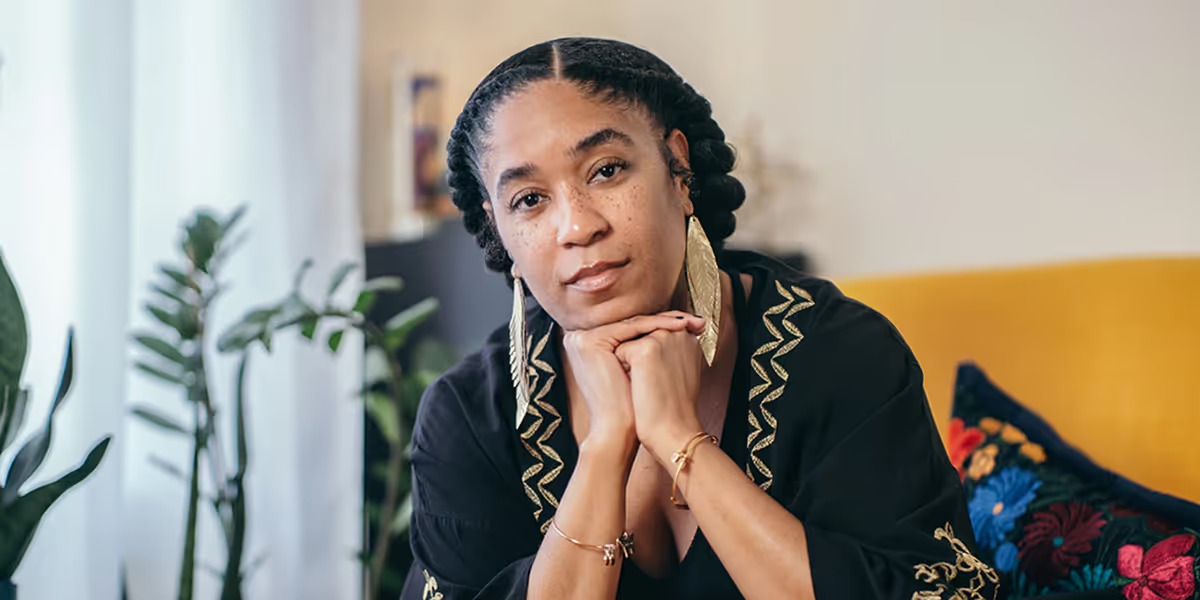
Lawyer, professor, tap dancer, choreographer, oral historian, legend. Over a long and illustrious career, Germaine Ingram has accrued a lot of descriptors.
She is also one of ArtPhilly’s curatorial collaborators, a group of cultural leaders called upon to help source and develop projects for What Now: 2026. She knew just where to look — Ingram was already partnering with Shavon Norris (artist, educator, facilitator) for “The Croning,” a project that will debut in November 2026 at Christ Church in Old City. According to Norris, that piece is her “way of investigating and creating community as I age,” and places her at the feet of the Black women she wants to learn from, including Ingram. What if they flipped the script? What if they shifted Norris’ position from learner to elder? How would that complicate this continuum of experience and mentorship? “The Becoming” was born. Five women, ages 11 through 40, who see Norris as a mentor — “like I see Germaine as a mentor,” she says — will contribute to this piece for What Now: 2026. We chatted with Norris and Ingram about how the project came to be, the complexities of aging, the crisis of Black womanhood, and their creative process.
ARTPHILLY: TELL US ABOUT THE IDEA BEHIND “THE BECOMING.”
Shavon Norris: I'm 48 and, for me, I don't want to wait to be named an elder because I look like one, or because I present as one, or I'm acting like one. There's something about waiting for society to decide that I'm having an impact. I know people are listening to me. I know people are watching me. I know people are considering how I'm living my life as an example of how they want to or an option — the better word is “option” — on how they can go. So these five women, we're going to interview each other, and then they're going to interview other women, and we're going to create an installation art project and presentation performance around what they desire and what they need to feel whole and well and healthy. I don't want us to get the information of what Black aging women bodies could look like from other people. I would like that to come from us — for us to generate for ourselves what we would like that to be, and feel like in the world, and in our bodies. It's helping me as an artist, but most importantly, as a human, to think about my trajectory, but also to include the trajectory of people coming behind me. I can make informed decisions about the type of elder I want to be to the people that I'm eldering.
ARTPHILLY: I THINK THE RELATIVITY OF THIS IS SO INTERESTING. AGE IS SO RELATIVE. I’M IN MY EARLy 40S — AT CERTAIN TABLES I FEEL LIKE A YOUTH AND AT A LOT OF TABLES I FEEL LIKE AN ELDER. SO I THINK THAT IS VERY RELATABLE, ESPECIALLY IN THAT MIDDLE AGE, RIGHT? THAT PIVOT POINT.
Shavon Norris: I'm curious about being excited about aging. I exist in a culture that wants me to “Gua Sha” my face every day and do yoga Olympics on my face and use every cream and everything. And I'm curious about having an experience where it is normal and encouraged and supported and celebrated to actually let my body do what it's going to do, and not be in conflict with that. I don't want to be in conflict with my body, even as perimenopause does its things to me. I'm inviting myself to surrender and taking it as a compliment and a triumph that I'm here for as long as I've been here. I want to be present. To be fair, I am not a person that is on TV. I'm not a person that's in the movies. I'm not a person that has to constantly be worried about people judging my appearance. I'm not saying that what other people are doing is wrong. I don't really care. I feel like, y'all got the money, you got the time, do what you need to do.
Germaine Ingram: I think Shavon is being modest about the potential impact and urgency of this project, because it's not just about appearance.
Shavon Norris: It's about life and death, yes.
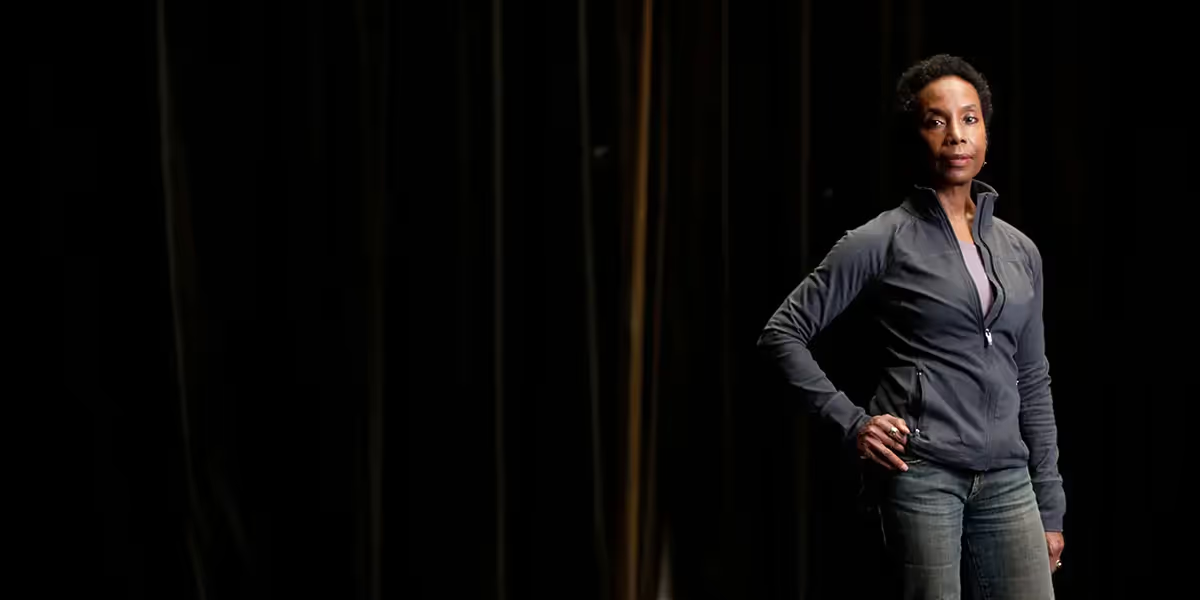
Germaine Ingram: I'm here. I'm breathing at age 79, so you know, issues of mortality, and independence versus dependence, and disability are ever-present in my life. But we're also living at a time — well, I don't know when there wasn't a time — when there's really a crisis for Black women and girls that endangers their lives. We just recently saw that in Philadelphia with a young woman [Kada Scott] who was found in a shallow grave. But also the women and girls whose options are limited, where perceptions constrict their ability to live rich and fulfilling lives. This is about the young women participating in this project, but it's also a way of thinking about how, in the larger society — and I'm particularly focused on Philadelphia — the crisis for young black women and girls can become more visible so that we as a community can develop more strategies of support and uplift.
Shavon Norris: Support, uplift and action. I'm curious about what I need to do for them and how I can support them. Like this little small group, for me, is a microcosm. Getting really specific in art allows us to see the universal — what is cultural for us, what is systemic for us, what we need to tend to. I'm interested in inviting our voices to be heard, and having my body be one of the ones to listen and sit at their feet, like I'm sitting at Germaine’s.
Germaine Ingram: All this is 360, you know, regardless of age. I'm looking at the whole circle — the people who are involved in “The Croning” and the people who are involved in the ArtPhilly project of “Becoming.” I think the beauty of this project is both its complexity and its simplicity and its circularity. I don't think of myself being at one end. I feel myself moving throughout this landscape. It's very exciting for me. Truthfully, I was thinking that 2025 was going to be a year off. You know, my feet are tired sometimes. But I'm just so excited about this opportunity to really gnaw on difficult issues with people like Shavon.
ARTPHILLY: HOW DID YOU FIND THESE FIVE WOMEN?
Shavon Norris: I found all of these bodies because they considered me like a big sister in some way. I have a tendency to work with people that I already have a relationship with. So my niece is in it; one of my present Temple students; someone who graduated from college a couple of years ago and is now out here working who is 22; someone who is a PhD student that I taught a couple of years ago; and then somebody else who is exactly 10 years younger than me. These are all performing bodies — even my 11 year old niece just got cast in the school musical as the Mad Hatter.
ARTPHILLY: SO WHAT IS THE PROCESS GOING TO LOOK LIKE? HOW ARE YOU GOING TO PUT THIS TOGETHER?
Shavon Norris: The resulting project will feature three elements: portraits that are going to be taken and used in the space, recorded audio of interviews, and times when the participants will move and activate the installation. There will be sessions with me where we talk about what we envision, what we dream of. There will be time with Kimmika Williams-Witherspoon, a visual ethnographer who teaches at Temple. She's going to train us on how to look at things and listen and see. We're going to use that as a way for the young women to explore the stories of their humanity, the stories of others, and we're going to do some interviews with them and the black women bodies in their lives that have impacted them. I'm actively inviting myself to imagine my future so that I can be more present in my present, right? I've been researching how African religion deals with time differently than Western American religion deals with time. And there's this concept of building the future, as opposed to it just happening upon us. What I'm doing now, every moment, is building the future. Thinking about my options for my “Germaine experience” at 79 is exciting for me right now. Yes, call me “crone.” My future is Germaine Ingram. I'm ready. And it makes it an exciting thing to age — it still can be scary, but I want my 78th year to be my busiest dancing time. Everywhere I look, Germaine Ingram is on stage. I want that.
Lead image: Shavon Norris; photo by David Evan McDowell