In Kensington, Seeing the Forest for the Trees
Under the umbrella of What Now: 2026, “Rewilding Philadelphia” is transforming a green lot into a dense biome to be used as a public space.
.avif)
A mini forest is coming to Kensington!
Under the umbrella of ArtPhilly and What Now: 2026, “Rewilding Philadelphia” is transforming a green lot into a dense biome to be used as a public space.
The project is inspired by the amazing Miyawaki Method. Developed in Japan in the 1970s and experimented with in cities across the globe, the technique stimulates rapid growth via density — carefully selected native plants compete for light and resources, leading to lush, biodiverse spaces that improve soil quality, provide shade, and create habitats for birds, insects, and people.
.avif)
Pete Angevine & Steven Dufala | at Sketch 2025
The man at the helm of this local activation is Pete Angevine.
He has been living and working in Fishtown for over 20 years.
A longtime musician and convener of people, he is a former owner of Little Baby’s Ice Cream, the small-batch brand known for its offbeat branding and creative flavors. (Remember this viral ad?). He doesn’t necessarily call himself an artist, instead embracing the moniker “creative producer.”
“I feel like that's largely my role in this project,” he says. ”Getting the right people and ideas and resources and possibilities into the room, and trying to clear a path for a collaborative co-creation.”
We chatted with Angevine about his relationship with the neighborhood, his longtime fixation on Miyawaki, and his dreams for the forest in the years to come.
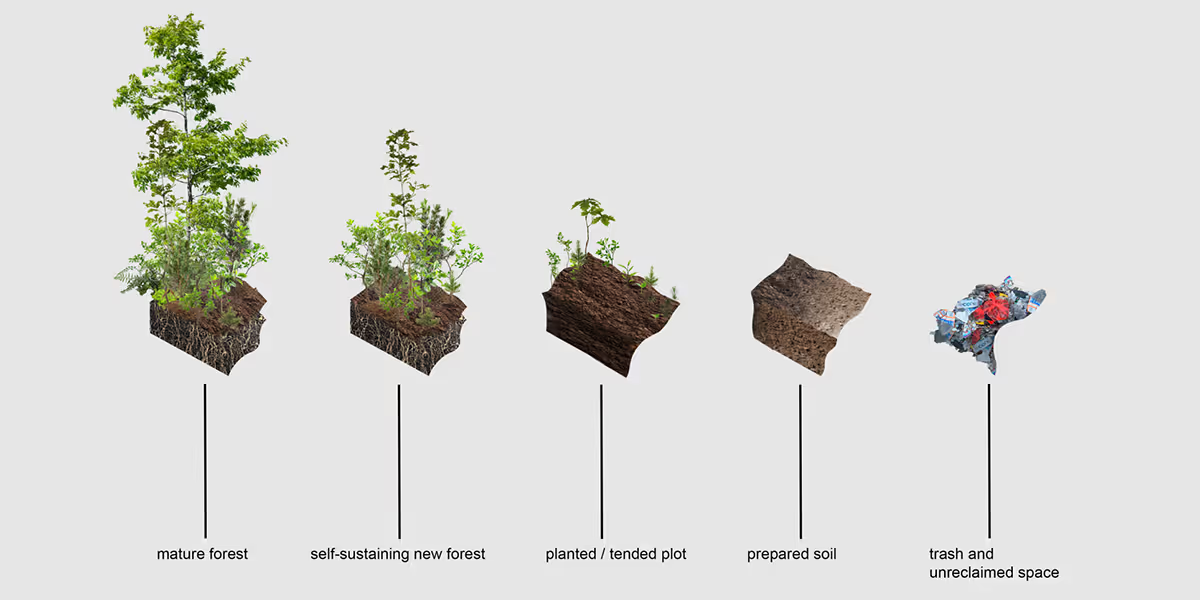
Pete Angevine & Steven Dufala | Installation Diagram
ArtPhilly: How did you first conceive of “Rewilding” and connect with ArtPhilly?
Pete Angevine: Personally, I have a deep and abiding obsession with forests. I like to be in forests. I like to read about forests. I like to think about forests as communities. I came across the Miyawaki Method maybe five years ago and wondered why it hadn't been done in Philadelphia yet.
So I have been trying to plant seeds about this idea for a number of years, talking to people I know in public works and public art. About a year ago, ArtPhilly decided to get behind this project and make it one of the commissioned works for the festival, which gave me the confidence to start formally approaching partners and looking for a site.
My colleague at The Academy of Natural Sciences of Drexel University, Ryan Strand-Greenberg, is executive director of civic engagement there. He became very excited about this project and has a lot of experience working in Kensington through Mural Arts. So he was able to bring in both of those organizations and connect us with New Kensington Community Development Corporation (NKCDC), which has been working in Kensington for 40 years. We were able to determine together — through conversation and negotiation — that what we’re looking to do really aligns with the ongoing greening work that they're doing in Kensington.
Tell us more about the different elements of this project.
“Rewilding” keeps getting deeper and deeper, with these various layers and spores coming out from it. We're going to work very closely with the neighbors who live around the site to think about how this forest should be laid out, and what other kinds of activities could take place within this soon-to-be new public space. The site that we're looking at is 10,000 square feet, and we're planning to plant something like 4,000 square feet of it. So there will be plenty of space for other elements. It could be a nature-based playground. It could be like an open kitchen situation with grills and sinks. It could be meditation benches or walking paths, etc. It could be a performance space. All those decisions are going to come from our months-long community engagement process.
And there are some other layers to this: Typically in Miyawaki forest projects, volunteers do all the work. But due to the specific conditions in the Kensington neighborhood, we know that it will be helpful if we can put cash in people's pockets. So we're going to recruit neighbors and community members to work with us, to learn about the Miyawaki method, to plan it, to plant it, and then for three years after the planting, we're going to pay them to maintain it. They are also going to work with research scientists at the Academy to monitor the ecological impacts of the planting on several different specific environmental justice indicators, including air quality, lead, soil contamination, urban heat index and biodiversity.
And then for three years, there's going to be an embedded artist in residence, working with the neighbors to beautify the space via art and sculpture, but also to build functional items like storage sheds or benches. That artist is Pedro Ospina, a really amazing community artist known for a South Kensington project called the Open Kitchen Sculpture Garden. He's been running that really cool, visionary public space for 10 years now.
Pedro will also have a fellowship at RAIR so that he can source his art-making materials from the several tons of construction and demolition waste that go through their facility every day. We're aiming to have whatever he builds be made out of nearly 100 percent recycled materials.
So when it comes to the land, what were you looking for? What are the things — ecologically, environmentally, geographically — that will make this forest thrive? And then, of course, in a dense urban space, how do you find enough land to make this work?
I've lived pretty close by for over 20 years, and I didn't even know this little pocket was there. It's kind of tucked in between Somerset Street and the Lehigh Avenue Rail Viaduct — a little setback three-block-by-three-block area made up of a bunch of one-way streets that terminate at this empty field that used to be a factory. And then for much longer, it was a rubble field where there was a lot of drug activity, dumping, homeless encampments and violence. Maybe five or six years ago, NKCDC purchased it, stabilized it and fenced it.
.avif)
Pete Angevine & Steven Dufala | Installation at Sketch 2025
What is the dream when you think about the long horizon of this project? And what inspires you about the Miyawaki method in particular?
Rewilding Philadelphia intends to be a much larger initiative. This project on Jasper Street is the first of what I hope will be many such pocket forests around the city. My hope is that it is a demonstration. It's an example. At the end of this three year period, we're going to take all the findings that the community science comes up with, and we're going to create a report and publish it. We will make the case that there should be more of these projects all over the city. And my hope is that the crew that we have recruited and trained and are paying to do this work — made up of Kensington community members — can then be hired to do these projects in other neighborhoods.
Part of the Miyawaki Method is the concept that by employing this methodology, trees mature faster. You can have a mature hardwood native forest in not 200 to 300 years, but more like 20 to 30 years. My hope on Jasper Street is that, in perpetuity, it becomes a new old growth forest that is an active site of gathering for birds and bees and bugs and humans. And I hope that when ArtPhilly does its festival again in two or three years, we can come back and have programming in the space.
Are you familiar with the Wissahickon?
Of course.
A fact that I have been obsessed with for 15 years is that, prior to the 1860s, the Wissahickon Valley was the most industrial part of the most industrial city in the world. Back when Philadelphia was known as the “Workshop of the World,” there were over 50 mills along the creek. Now there's hardly a trace of that, and it's just beautiful. It's the largest contiguous natural area in any major city in the U.S.
What's another post industrial neighborhood here in Philadelphia? Kensington. It's only because a bunch of folks in the 1860s decided to buy up all that land and turn it back into a forest that we now have this cherished natural asset in Philadelphia. So hopefully this is another one for the future.
How do you feel “Rewilding” fits within an arts festival? And within a slate that also features much more traditional forms like theater, visual arts, and music?
I definitely know it's different. I guess for me, that's nothing new. I never really fit in anywhere.
Why is this art? I don't necessarily even know what art is, and I'm certainly not the decider of whether it is or not. But I think when you have this many people coming together to creatively solve a problem, that sounds like art to me.
When Bill Adair first told me about ArtPhilly and the guiding quest/curatorial question of “What Now,” this was the knee-jerk-reaction answer. We’ve got to fix it. We’ve got to put back everything that we took out from our city, in terms of the natural world. A big emphasis of this project is to remind us all that we are part of nature. We're more than connected to it — we are it. And so I hope that this process and the result of it will remind us of that. If the legacy of the last 250 years of America was demolishing — steamrolling everything and paving everything and putting up these tall buildings — at least part of the next 250 years has to be putting it back.
For more on Rewilding Philadelphia, visit the project page.
For more articles like this, subscribe to the newsletter in the footer below!