In Conversation: Pepperpot
ArtPhilly Curatorial Director Tania Isaac interviews Pepperpot collaborators V. Shayne Frederick, Eric Battle, and Dr. Kendrah Butler-Waters
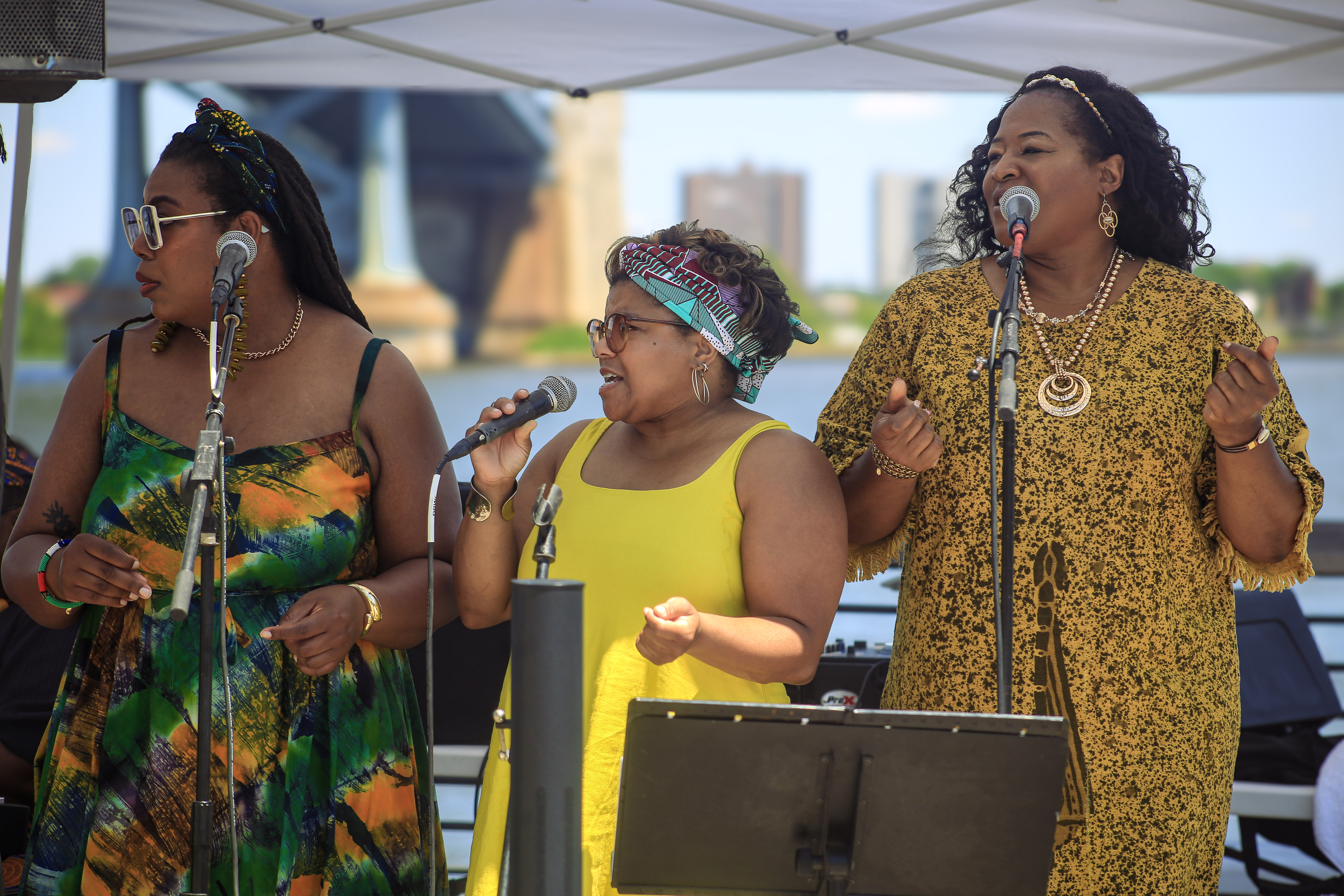
On a sunny day in June, Pepperpot made its debut on the Race Street Pier. Part live concert, part visual arts exhibition, and part culinary experience, the multidisciplinary project was originally conceived by Homer Jackson, the late artist and founder of Philadelphia Jazz Project. After his passing, jazz artist V. Shayne Frederick worked in close collaboration with Jackson’s widow and creative partner Lynn Washington to bring the inspiration to fruition.
Attendees swayed and nodded their heads to original compositions from pianist and bandleader Dr. Kendrah Butler-Waters that echoed the songs, chants and stories of the pepperpot street vendors. They saw vibrant painted portraits of imagined unsung chefs painted by Eric Battle. And of course, they learned about the diasporic history of this signature soup — a dish served in Colonial marketplaces by Caribbean and African-American women — all while sampling pepperpot soup from chefs Valerie Erwin, Omar Tate and Chaz Brown.
ON FRIDAY, NOVEMBER 13 FROM 5PM–8:45PM, Pepperpot will return, this time hosted by the Philadelphia Museum of Art for their Pay What You Wish Friday series. The same band of musicians will be back, and Battle’s paintings will be projected in the Great Stair Hall near the iconic Diana statue.
Recently, ArtPhilly’s Curatorial Director Tania Isaac spoke with project collaborators V. Shayne Frederick, Eric Battle and Dr. Kendrah Butler-Waters:
Tania Isaac (TI): Shayne, tell us a little about the project’s inception. In your conversations with Homer, what did you promise you would carry forward?
V. Shayne Frederick (VSF): Really, it was just making sure the project goes forward. It wasn’t fully formed at that moment. We knew that for that first iteration, Chef Valerie Irwin was going to be a part of it, Eric Battle was written in… other than that, no one was written in. We hadn’t identified what the music sounded like explicitly, who was going to be on the music, whether it was going to be a local ensemble, was it going to be different sets and different groups… [but] after it was approved, then it was like, “All right, let’s figure it out!”
And then Homer passed away in July [2024], but there were some things that were still up in the air. This is a trifecta of visual art, culinary art, and a musical thing. The culinary and the visual were there; the musical aspect really was the question mark.
One of the times I called Homer, Kendrah was actually there, at his bedside at the hospital. We all have a specific type of relationship with Homer for those of us who collaborated with him a million times over in the decade or so that the Philadelphia Jazz Project was alive… She was as much a colleague and co-conspirator as I was, so I knew she was invested in his legacy and his work. So I said, “Listen, Kendrah, so we got this thing. How about I make you the music director?” It made perfect sense. She’s like, “I’m in, this is great.” So it afforded her the opportunity to be a part of Homer’s last project as well.
So it was symbiotic. Another time I was calling and checking in, and Homer said, “Mr. Shayne, I think I’m about to get out of here.” I’m like, “Homer, you know you don’t have to go. And he was like, “No, I’m about to get out of here, but you’re gonna take care of my project for me?” And I was like, "Of course I am.” I knew it was imperative that that’s what I needed to do.
And Eric, you had some conversations with him as well that were similar to that in those last moments. And you felt committed to that assignment, however it showed up.
Eric Battle (EB): Absolutely. All of us who have been able to have the pleasure of knowing him for so long and have the pleasure of working with him, this just had to happen– and it happened so beautifully. It’s one of those things where you felt that it had to happen, and I’m so thankful and grateful to be a part of it in whatever form possible.
TI: Could you share some of your initial conversations, Eric?
EB: He had proposed the project a couple of years ago and whenever he and I would talk, he would shoot off a whole bunch of ideas. And for me, I know that he trusted my viewpoint on whatever ideas he would throw at me. I don't know if everyone has had the experience of things that he put on across the city during the Philadelphia Jazz Project — [but] so many of those performances were just mind-blowing events. So, yeah, it was an absolute and immediate yes for me. It was always an immediate yes.
VSF: Homer had a running list of ideas he’d been waiting to bring to fruition… to choose the one for this specific moment, a large context that felt relevant historically. Not just a jazz concert by the river, but something that had historical weight to it that was talking about the past, the present, and the future.
I probably still have those [ideas] down on a piece of paper. He was like, “What about this one? What about that one?” And I said, “I think Pepperpot is the one. This is the one we need to work on.” This was the time and this was the setting and this was the opportunity.
TI: Eric, how did you get from the images to the actual portraits that you created?
EB: So, we met at a restaurant in Old City–
VSF: It was a Nigerian restaurant called Eat Well. I wanted to meet at a place that, one, had the pepperpot soup that was closer to the root of the African version, (not the Guyanaese version and not the Philadelphia version) and that, two, it was close enough to the site that we were thinking about. But finish the story, Eric!
EB: So that afternoon, we all met at Eat Well and were going over the details of what the project could look like and then recognizing that there were going to be three portraits. And it was evident to me right there at the table that if I'm going to make up these portraits, why not use the three incredibly beautiful women who are sitting right here at the table?
So Kendrah, with [Teaching Visual Artist] Asake Denise Jones and Chef Valerie Erwin were the references for each of the portraits. It really all just fit together so well. And then once I made that decision, we ended up walking over to Head House Square and took photos of the surrounding areas I figured I would need for reference shots. To me, that was another sign that this had to happen — because everything I needed was just right there.
TI: Kendrah, I would love to hear how you got connected to the project and what made it compelling to you?
Dr. Kendrah Butler-Waters (KBW): Right before Homer passed, Lynn [Washington, Homer’s wife] had called all of his folks and all of the folks connected to Philadelphia Jazz Project and said, “Hey, you really should see him before he transitions.” And during that time, I’d gone to the hospital because I was actually meeting up with a musician friend of mine — a few musicians had visited on the same day. But on this particular day, I was just finishing another commissioned project and the music hadn't been realized yet. And I knew that I wanted him to hear it. So I brought the speaker and was talking to him, making him laugh, and talking about Frosty [a holiday concert series produced by Philadelphia Jazz Project], and a whole bunch of other projects that he had put together.
Homer was a “bridger” of people, a bridger of experiences, a bridger of talents…so what’s interesting is he was talking about this project before I even knew what it was, and this was even before Shayne had reached out. Homer was all about collaboration and an interdisciplinary experience for people in Philadelphia that was specifically about jazz. He had just found out that he had gotten the funding for this project and he asked Lynn, “who’s going to take the reins?” and Lynn just said, “Listen, it’s in good hands. Don’t worry, we got you.”
Shayne was the perfect person to actualize his vision because he really knew Homer. And with Homer’s vision of where things were supposed to go, he knew Shayne was going to bring this to life with Lynn. Shayne is definitely a “bridger” of people, a visionary of his own right; he was the perfect person to take the torch that Homer had put together. And Shayne reached out and was like, “Hey I got this project. It’s about African and Caribbean women who created this monumental soup, its inception was here in Philadelphia and it has several iterations of it…”
I’ve realized now that I love doing projects that have a historical element, an element that focuses on the empowerment of black women — the beautiful vision of what black women contribute to what is American history. It isn’t just black history: It is American history and how the tentacles of the things that we create extend far and wide and deep.
When he told me he wanted to focus on the historical elements, I went into research mode. I found some of the senses of that time, where black women were working. Some of these merchants of this soup, these women’s entire economic foundation was based on them selling soup in the streets. And some of the historians I saw had been talking about pepperpot, and even shared names that were recorded during that time of, what we would say are, “pepperpot women.” I knew I wanted to write seven songs, I knew I wanted to have the songs expand and demonstrate the life of pepperpot women from the African diaspora and the Caribbean diaspora, and focus on some of the genres of that particular group, in addition to having it really entrenched in jazz, as well as being Black American classical music.
The interesting thing about the names of the pieces, the first names are names of Pepperpot women: Juansheeba, Mary, Ruth, very strong names. Then, I thought, “I want to honor the people who were the original contributors to this interdisciplinary experience of Pepperpot.” So for Eric Battle, one of the pieces is called “Elizabeth Battle,” and there’s “Mary Frederick,” “Heddy Waters,” “Hester Washington” for Lynn, “Ruth Erwin” [for Chef Valerie Erwin]. “Juansheeba Jackson,” the opener, is really an ode to Homer, since this was his project.
For an all-black female ensemble, I knew exactly who I wanted to call on, who would get the vision, understand the seriousness of the music while incorporating the freedom in it, the improvisational essence of the music, along with vocalists who I knew could sing, but also could add in the theatrics of what I was trying to convey through the lyrics.
We had such a good rehearsal and time to talk through things and then Shayne was like, “We need to document this, you know how Homer was.” Homer was all about documenting things. So we went to Spice House Sound and we recorded it. The music is phenomenal. What a way to honor Homer and a way to timestamp it as a historical view that will continue to live on.
TI: Were you all aware of what would unfold at the Pepperpot performance during What Now: 2026?
EB: It was all an extremely pleasant surprise to see how everything had come together. I’m always just blown away by the incredible music that Kendrah puts together. I was so excited to work on the pieces because this was a chance for me to paint again. I hadn't painted for a while, so I was just really excited to jump into this other medium and explore what else can happen there. Having Kendrah and Asake and Valerie as the reference points for each of the pieces, it just added to more of the excitement for me to make these pieces happen. My initial sketches are vastly different from where I ended. I was working on them from our early discussions about cowrie shells and all of these elements I wanted to incorporate into each of the pieces; I was trying to cobble them all together and they just weren't working for me. But then something clicked and the configuration of all of the elements really started to come together for the pieces. Just visually that’s one of the most exciting parts of coming up with any kind of composition; recognizing something to be as lively and almost musical to match the sounds that Kendrah was going to create for this.
KBW: When Eric was sending his sketches, all of us were blown away. I didn't know what to expect. The lyrics were assigned to the persona he created. I had to stare at it for quite some time to take in all of the elements he included. It was so much — it’s visually so gorgeous, and I thought it brought the music even more to life.
TI: We went from the pier outside during the festival, to the Philadelphia Museum of Art coming up on Friday. How do you imagine this new version of Pepperpot?
VSF: I guess for me it was an easy transition, because I love the fact that we could outsource the soup and have it done well. It was extremely difficult and expensive to try to produce a kitchen outside [laughs]. We’re keeping the main thing the main thing. The soup is there. It’s not about the making of the soup as much as it is about what the soup represents. It’s really about art and the music. We can take this anywhere. Kendrah can take her work anywhere. And the ability to project Eric’s dynamic art around Diana [in the PMA] is beautiful.
EB: When I found out it was going to be at the PMA, that excited me. Just having my artwork somewhere at the museum… having it projected on the wall is just incredibly exciting.
I don’t know that I'm going to be able to make it that night. That night I have an opening at Ultra Silk Gallery– but, just the thought of having my artwork somewhere in the Museum of Art is just incredibly exciting, so, thank you.
KBW: You are 100% deserving of all of those flowers. The artwork is insane.
I am so stoked for November 13. I love the acoustics of the art museum, so to have this interdisciplinary experience for people to take in, and of course, Eric’s artwork, a swinging pendulum from the past to current and giving a different outlook of the pepperpot experience, and then weaving in some of the music that supplements the visual artwork in such a powerful way, it will be a great experience for people to witness some really cool work.
TI: It’s a more contained space so being immersed in it is really resonating with me.
VSF: I do want to make note that they do have the painting in the museum, [Pepper-Pot: A Scene in the Philadelphia Market] by John Lewis Krimmel. And I look at this experience as, dare I say, a correction of that painting. The painting depicts a woman serving these other people. The woman herself almost seems to be an object, not the subject of the painting. [Our project is] very much “we are the object and the subject of ourselves.” And I think that’s a very important correction. It’s a very beautiful painting. However, I very much enjoy Eric’s paintings where the focus is on her, who she is and her personality and her being a full human being rather than being a servant and a server to the white people of colonial Philadelphia. I do think it’s a necessary correction. I think it’s very important that it happens [at the museum].
KBW: I agree. As Toni Morrison would say, it takes her out of the white gaze and puts her right into her own view of who she is, reclaiming her part of history.